


Welcome to Conscious Breathing: The 7 Steps
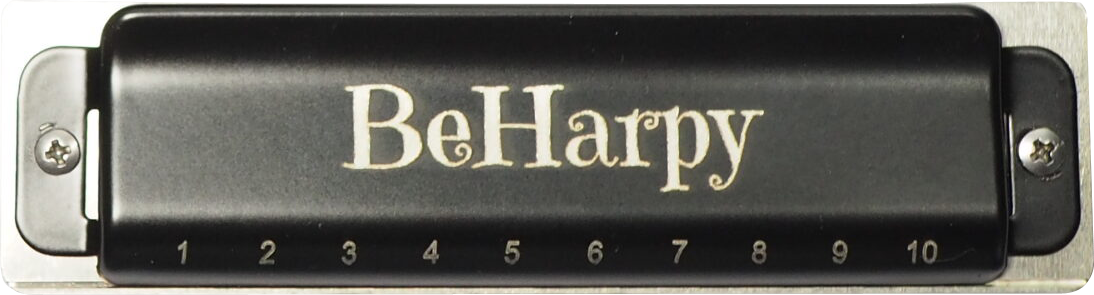


BeHarpy offers you the ideal harmonica for the course CONSCIOUS BREATHING: The 7 Steps, a professional, personalized harmonica at a very affordable price.
Contact me if you are interested!!!

AWARENESS / CONNECT WITH YOUR BREATHING
BREATHING AS A THERAPEUTIC PRACTICE / IMPROVE YOUR BREATHING HABITS
RELAX ON DEMAND / GET TO KNOW YOUR AUTONOMIC NERVOUS SYSTEM
ENERGIZE YOURSELF ON DEMAND / ACTIVATE YOURSELF BY PLAYING HARMONICA RHYTHMS
BREATH AND MOVEMENT
BREATH AND CONNECTION / HARPFULNESS
BREATH AND INTENTION / ACTIVATE YOUR HEALING ENERGY
You are about to embark on a journey that will help you improve your breathing habits, learn ways to deal better with uncomfortable situations and become familiar with a new instrument: the harmonica.
Step by step, you will start to create a more intimate relationship with your breathing; you will get to know each other better, you will discover secrets and practices that some cultures have been using for thousands of years, and work on your body, mind and emotions with the most fundamental human action: breathing. Sound and vibration will accompany you along the way through a good old harmonica.
Take your time to work on every Step and come back to it whenever you see fit. This is not a race, this is about learning new tools that might help you feel better, more connected to yourself, happier and even healthier. This is not magic or miraculous, but then, what is? This is about creating a ritual of self-care and self-love, about doing something for yourself and feeling good about it.
The 7 Steps can help you improve your breathing habits and can make you healthier; it can show you new ways to deal with stress and anxiety, but it should never be a substitute for any medical treatment whatsoever.
CONNECT WITH YOUR BREATHING
The first thing you need to do if you want improve your relationship with your breathing is to observe it, as simple as that, as simple and powerful as watching yourself breathe. Your body breathes by itself; you don’t need to do anything at all. Try not to intervene, not to judge, just watch and be present.
Being conscious of your breathing is the first step of a long journey that can change your life.
Find a comfortable posture, put your harmonica in your mouth and just listen to the way you breathe. You can close your eyes to connect deeper with yourself. See how this practice can right away become a sound meditation by itself.
IMPROVE YOUR BREATHING HABITS
Now that you are good at observing your automatic breathing, it’s time to take some more action. Our first therapeutic practice is called Coherent Breathing (Stephen Elliott).
When we decide to take deeper breaths, we engage our diaphragm in such a way that we activate what is called the “thoracic pump”, a physiological mechanism to move blood and lymph. The diaphragm actually does part of the heart’s job, thus giving it a rest and lowering our heart rate, as a consequence our blood pressure goes down and our whole body relaxes. When our body relaxes, our mind relaxes too. The fact that we can decide how to breathe, voluntarily or involuntarily, is not a coincidence, and we can take advantage of this! Coherent Breathing is a great practice to balance your nervous system, quiet your mind and can easily bring you to a deep meditative state. Mind you, it will also help you sleep better!
It’s also a great exercise to start improving your breathing habits, such as avoiding shallow breathing and chest breathing.
For this practice we will breathe at a rate of 6 breaths per minute, less than usual: we will inhale for 5 seconds and exhale for 5 seconds without pauses nor holding between breaths. We will focus on trying to breathe from our belly. Your belly should expand outward as you inhale, indicating that you are using your diaphragm efficiently, and deflate as you exhale.
You can also try 4 seconds in 4 seconds out, 6 seconds in 6 seconds out, 7 seconds in 7 seconds out, and so on. Choose the rate you feel most comfortable with. Try doing it for 5 minutes, but 10 minutes is even better!
The audios will help you follow the different breathing patterns: 4×4, 5×5, 6×6, 7×7 and 8×8. Release all the air in your lungs when you hear 3,2,1 and start by inhaling. The harmonica sound will accompany you for 2 minutes, then you are on your own with the metronome.
Once you are good at it, you can get creative and inhale and/or exhale doing octaves, splits, bendings, overblows, etc…
Bear in mind, though, that the most important thing is to do the practice in a relaxed way. Don’t let harmonica technique ruin the exercise!
The sound of the harmonica will help you focus, control the airflow and quiet your mind. Once you notice you start relaxing, tension in different parts of the body may arise. This is the perfect time to work on your posture, to correct it. Once you are comfortable, you can start working on your tone too, opening or closing your mouth cavity.
Our brain is constantly scanning our body and giving orders to control our involuntary functions through our autonomic nervous system, split into the sympathetic mode (fight or flight) and the parasympathetic mode (rest and digest). As we said before, the only function in our body that can be both voluntary and involuntary is breathing. This means that breathing is a great way to use our body in order to influence our brain effectively. When we get stuck in a sympathetic state for too long, stress or anxiety starts to pop up, with the risk of even becoming chronic. By lengthening our exhalations, we stimulate the parasympathetic nervous system via the vagus nerve and we tell our body it’s safe.
In breathing, we associate exhalation with relaxation and inhalation with activation.
For this practice we will breathe in for 3 seconds and out for 6 seconds. Actually, any rate will work as long as the exhale is longer than the inhale. Find the one that suits you best: 3-5, 4-8, 3-9, 4-12, 4-16, etc… The longer the exhale, the better, as long as it’s comfortable for you. This is a great exercise to reduce stress and anxiety and it can be done at any time of the day. 5 minutes is enough to notice its effects, but 10 is even better.
The audios will help you follow the different breathing patterns: 3×6, 4×8, 4×12, 4×16 and 4×20. Release all the air in your lungs when you hear 3,2,1 and start by inhaling. The harmonica sound will accompany you for 2 minutes, then you are on your own with the metronome.
The sound of the harmonica will make the practice even more soothing and it will help you quiet your mind.
This is a great exercise to practice inhaling air through your mouth and nose AT THE SAME TIME, and exhaling air ONLY through your mouth; this is what Joe Filisko refers as the Nose Pull. When playing harmonica, having the ideal amount of air in your lungs, middle range is optimal, allows you to play better and more relaxed; you can use your nose as an escape valve to regulate that air. Try to maintain the same volume of the sound you are producing in the inhale and in the exhale. The inhale, since it’s shorter than the exhale, will force you to take in more air in less time. Using your mouth and nose AT THE SAME TIME to inhale (Nose pull) is a good option here, whereas during the long exhale you should ONLY use your mouth to release air.
As we said in Step 3, in breathing we associate exhalation with relaxation and inhalation with activation. So, when we want to activate our body and our mind we just have to focus on long inhales and short exhales.
This is a practice that will help you recharge and release tension at the same time.
We will inhale for 3 seconds and exhale for 1 second, as simple as that. Again, as in Step 3 any rate will work as long as the inhale is longer than the exhale.
The audios will help you follow the 3×1 rhythm pattern, first breathing only and then with articulation. Try the slow version first and then have more fun with the medium and the fast ones.
This is a great exercise to practice inhaling air ONLY through your mouth and exhaling air through your mouth and nose AT THE SAME TIME; this is what Joe Filisko refers as the Nose Push. When playing harmonica, having the ideal amount of air in your lungs, middle range is optimal, allows you to play better and more relaxed; you can use your nose as an escape valve to regulate that air. Try to maintain the same volume of the sound you are producing in the inhale and in the exhale. The exhale, since it’s shorter than the inhale, will force you to release more air in less time. Using your mouth and nose AT THE SAME TIME to exhale (Nose push) is a good option here, whereas during the long inhale you should ONLY use your mouth to breathe air in.
The harmonica will definitely make this practice a lot more fun! We will turn the exercise into a harmonica rhythm. For beginners this will be your first harmonica rhythm ever!
Make sure you listen to the audios where I play 4 different rhythms that focus on the inhale!
The rhythms starts at 60 bpm so you can learn them, and then they double to 120 bpm.
Many mindful disciplines, like yoga and tai chi, or different martial arts, like aikido, connect breath with movement.
In today’s practice I invite you to let your body lead the rhythm you create with your harmonica and vice versa.
One of the easiest and most intuitive ways to embody a rhythm is by walking and playing harmonica at the same time, using your body as a metronome.
Start walking at a steady pace and begin by breathing in for 8 steps and breathing out for 8 steps. After a while, breathe in for 4 steps and out for 4 steps. In case 8 steps is too much for you, you can start by breathing in for 4 and out for 4. Then, breathe in for 2 steps and out for 2 steps. Next, in for 1 step and out for 1 step. Now, you can start playing with different rhythms, if you like. Try not to change your pace as you walk: use your body as a metronome. You will soon realize that this practice might lead you to your first train imitation! All aboard!!!
You can also pick up a lick, an easy blues scale for instance, and play it as you walk at a steady pace. Try 2 draw, 3 draw, 4 blow / 4 draw, 5 draw, 6 blow. Then, all the way down: 6 blow, 5 draw, 4 draw / 4 blow, 3 draw, 2 draw. Do it at a pace you find comfortable, don’t rush it!!!
I encourage you to be creative. You can also try to dance and play at the same time. Or watch someone else move or dance and try matching your harmonica playing with them.
Some spiritual practices use breathing as a way to connect with yourself, with your body, your mind, your emotions, some use it to connect with others and some to connect with nature and the whole universe.
Let’s start by connecting with ourselves. In today’s practice I invite you to be a bit more mindful when you breathe with your harmonica. I refer to this as a harpfulness practice, instead of mindfulness.
Find a comfortable position and start breathing at a rate you are comfortable with; the deeper you breathe, the better, but do so without forcing it. Focus on one part of your body, your heart, for instance. Close your eyes and start breathing into your heart, focus only on your heart. Feel how it expands and relaxes with every breath; feel the love, the compassion and the gratitude your heart is capable of giving. If you are holding the harmonica with your left hand, you can put your right hand upon your heart to focus on it even more. Try to feel the connection between you and your heart more and more.
You are welcome to do this with any other part of your body.
You can also try this exercise with a partner, so you can connect deeper with each other. Use a harmonica in the same key and try to breathe at the same rhythm. You can either breathe in and out at the same time, or one can breathe in while the other breathes out.
One of my favorite practices, though, is to connect with the nature around me. When I’m at the beach, for instance, I sit in front of the ocean and try to match the rhythm of waves washing in and out with my breathing and the sound of my harmonica.
In the woods, too, you can sit in front of a big tree and try to connect with it, with all the years it’s been there, patiently growing, and then, when you are ready, you can start breathing calmly with your harmonica, maybe to let it know how grateful you are, or simply to embrace all its wisdom.
Our thoughts and emotions carry energy. Intention is the key that activates change and directs our healing energy.
The first thing we are going to do is set a clear intention: What do I want to heal? What do I want to achieve? Try to be as specific as possible. Speak your intention with conviction before starting to breathe with your harmonica.
Find a comfortable position and start breathing at a rate you are comfortable with; the deeper you breathe, the better, but do so without forcing it. Keep focusing on your intention and matching it with the sound of your harmonica.
If your intention is to heal a specific part of your body, breathe in as if you are collecting energy and breathe out focusing on the part of your body you want to heal, directing all the healing energy towards that area.
If your intention is, for instance, about being more confident, more compassionate or grateful, about strengthening qualities of yourself, try also to be very specific about what you want to achieve. Think about it, make an affirmation, a word or a sentence: “I’m confident” or “I know I can do it”, for instance, and start repeating it every time you breathe in. As you breathe out, send the energy of that affirmation to all your body, to every cell of your body. Keep doing this for a while, and then picture the outcome as if it’s already happening. Imagine what your healed state or the new you is like and keep breathing. Let the sound and the vibration of the harmonica soothe you and help you reach your goal.