


Harmonica Breathwork
WHY BREATHING?
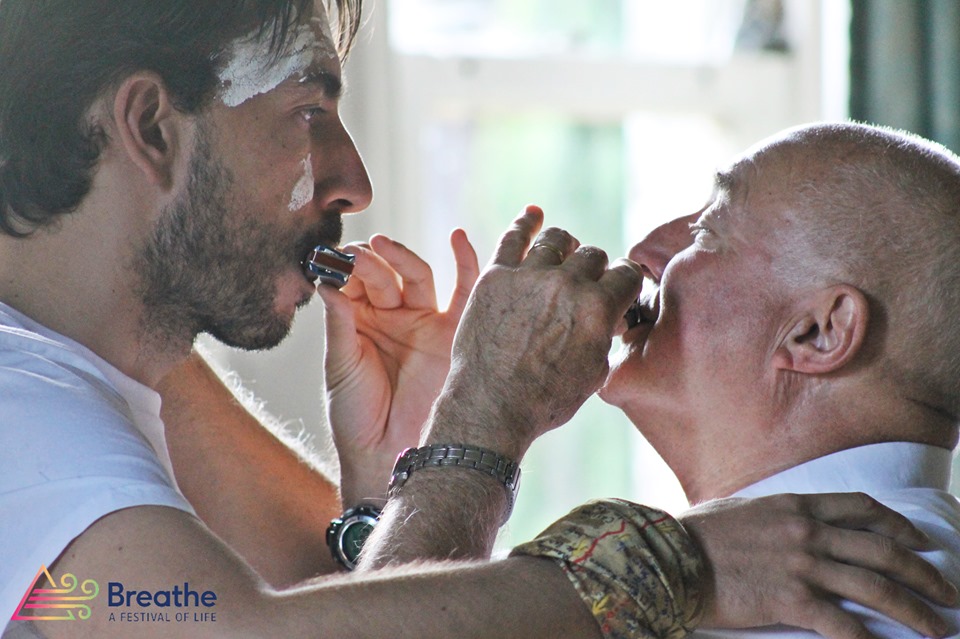
We breathe around 20.000 times every day; most of the time it is a completely automatic reflex, but breathing is the only function in our body that can be both voluntary and involuntary, and this is not a coincidence! Every emotional state is associated with a breathing pattern. By changing your breathing pattern, you can also shift your emotional state.
Being more conscious of your breathing helps you keep your mind in the present and allows you to develop your own resources in order to deal better with stress, anxiety and all kinds of physical and emotional issues.
Being more conscious of your breathing also helps you restore your good breathing habits, which translate into a healthier body and mind. Working consciously on them strengthens your immune system and helps you recover your natural healing processes.
Our health depends on how efficiently we breathe, but our mental health can also benefit from the way we breathe.
Breath is life, breath is freedom, and it only depends on you.

CONSCIOUS BREATHING: The 7 Steps
WHY HARMONICA?
The harmonica, being the only instrument that produces beautiful chords when inhaling and when exhaling, is the greatest amplifier of your breath, the perfect tool to explore your diaphragm and to gain more awareness and control of your breathing.
Playing harmonica is fun, makes you secrete endorphins and happy hormones, improves your breathing habits, reduces stress, cultivates creativity, helps you work on your frustration tolerance, promotes happiness in your life and those around you…
The harmonica adds up a bit of resistance to your breathwork and incorporates sound into your practice, two subtle features that can bring your experience to another level.
Harmonica also adds vibration to your practice, and it may be the only instrument that actually introduces sound into your body, being the only instrument that produces sound while inhaling and taking into account that we literally introduce the harmonica inside our mouths.
According to sound healing therapists, sound and vibration cure at all levels by the principle of resonance, and as Dr. Mitchell Gaynor says, director of Medical Oncology and Integrative Medicine at the Cornell Cancer Prevention Center in New York: “If we accept that sound is vibration and we know that vibration touches every part of our physical being, then we understand that sound is heard not only through our ears but through every cell in our bodies. One reason sound heals on a physical level is that it so deeply touches and transforms us on the emotional and spiritual planes. Sound can redress imbalances on every level of physiological functioning and can play a positive role in the treatment of virtually any medical disorder.”
There are two harmonica projects run by harmonica players and dear friends that deeply touch me for different reasons: the dedication, the determination, the groundbreaking work they do, often altruistically, always driven by the commitment to helping others, usually rowing against the tide of administration and bureaucracy… I’m talking about Chris Startup, from Northampton, and Sergi Raya, from Barcelona. Chris with his Harmonica for Lung Health project and Sergi with his Harmonicus project for children and the method he is developing in different hospitals for patients with respiratory issues.
Keep playing and keep browsing on BeHarpy’s website and you will find all the more reasons to fall in love with, as the great Mattias Bogefors calls it, the smallest gym in the world!
LET’S GET STARTED
Since we will basically be playing chords at BeHarpy, I recommend using a diatonic harmonica.
As a beginner you will usually buy a harmonica in the key of C, mainly because 99% of the courses and tutorials you will find to start playing the harmonica will use a C harp.
However, I find that a G harmonica, which has a lower, more soothing sound and requires a bit more air when you play, is more appropriate when working on breathing and even for mindful practices. So, if you intend to follow the videos I present in the course CONSCIOUS BREATHING: The 7 Steps, you will need a G harmonica.
BeHarpy offers you the ideal harmonica for the course, a professional, personalized harmonica at a very affordable price.
That said, you can also use other models from other brands, but I advise you not to buy low quality harmonicas, as they tend to leak too much air and the tuning might not be the best.
You can actually follow most parts of the course even without a harmonica, but you will miss some of the fun!
FUNDAMENTALS: HOLDING, POSTURE, TONE AND BREATHING
For this matter I will refer to the world’s foremost authority when it comes to harmonica, the second to none Joe Filisko. Anyone who wants to work on harmonica fundamentals should be familiar with his website www.filiskostore.com
If you are a beginner, you want to work on your fundamentals properly from the start.
If you are an intermediate or advanced player, the exercises I present are great for continuing to strengthen your fundamentals. Since, at first, the exercises don’t require difficult harmonica techniques, you can easily focus on your fundamentals while working on the breathing patterns I propose.
In the following video I talk about the four basic pillars that we need to pay special attention to when playing harmonica, especially when working on breathing with the harmonica: how to hold it, posture, tone and breathing, of course.
AND NOW, LET’S START BREATHING
So, who am I to tell you how you should breathe? Actually, I should not!
If you were born healthy, you started breathing correctly, because you used deep diaphragmatic breathing for efficient oxygen intake, and that was something you did instinctively.
As we grow, though, stress, anxiety, poor posture, stuck emotions and learned habits often shift our breathing to shallow chest movements or mouth breathing, engaging neck and shoulder muscles instead of the diaphragm. The fact is that a really high percentage of the world population, up to 90% according to some surveys, experiences dysfunctional breathing habits.
The good news is you can reverse them with a constant and simple practice, and a harmonica can make it really fun too!
I invite you to follow CONSCIOUS BREATHING: The 7 Steps, a course that will guide you, step by step, on a conscious breathing journey using the harmonica as the perfect tool to reconnect with your natural breathing and to develop your own resources in order to learn how to deal better with stress, anxiety, sadness, fatigue and all kinds of physical and emotional issues.
If you are new to harmonica this is also a great way to get familiar with the instrument.
If you are an intermediate or advanced player, you will realize that all the exercises and breathing patterns have multiple possibilities to work on different harmonica fundamentals and harmonica techniques, even the hardest ones. Sometimes you’ll just need to be creative with the exercises I propose. You’ll soon see what I mean!